Put the list where the thing happens
My son is seven. ADHD, plus auditory processing. For about two years our mornings were me saying the same four things twenty times each, and both of us miserable by 8am.
I'm a developer, so obviously I built an app. Quests, a little pixel hero, characters to unlock. My kids loved it for about two weeks. Then it turned into me nagging him to open the app instead of nagging him to brush his teeth. I had moved the nag from the bathroom to the iPad.
What eventually worked was almost an accident, and it wasn't a feature. It was a location.
The bench
I had built a full-screen mode: big picture tiles, one step at a time, a shrinking timer, a dumb celebration at the end. I put an old iPad in a fifteen dollar stand on the kitchen bench, opened that screen, and didn't say anything.
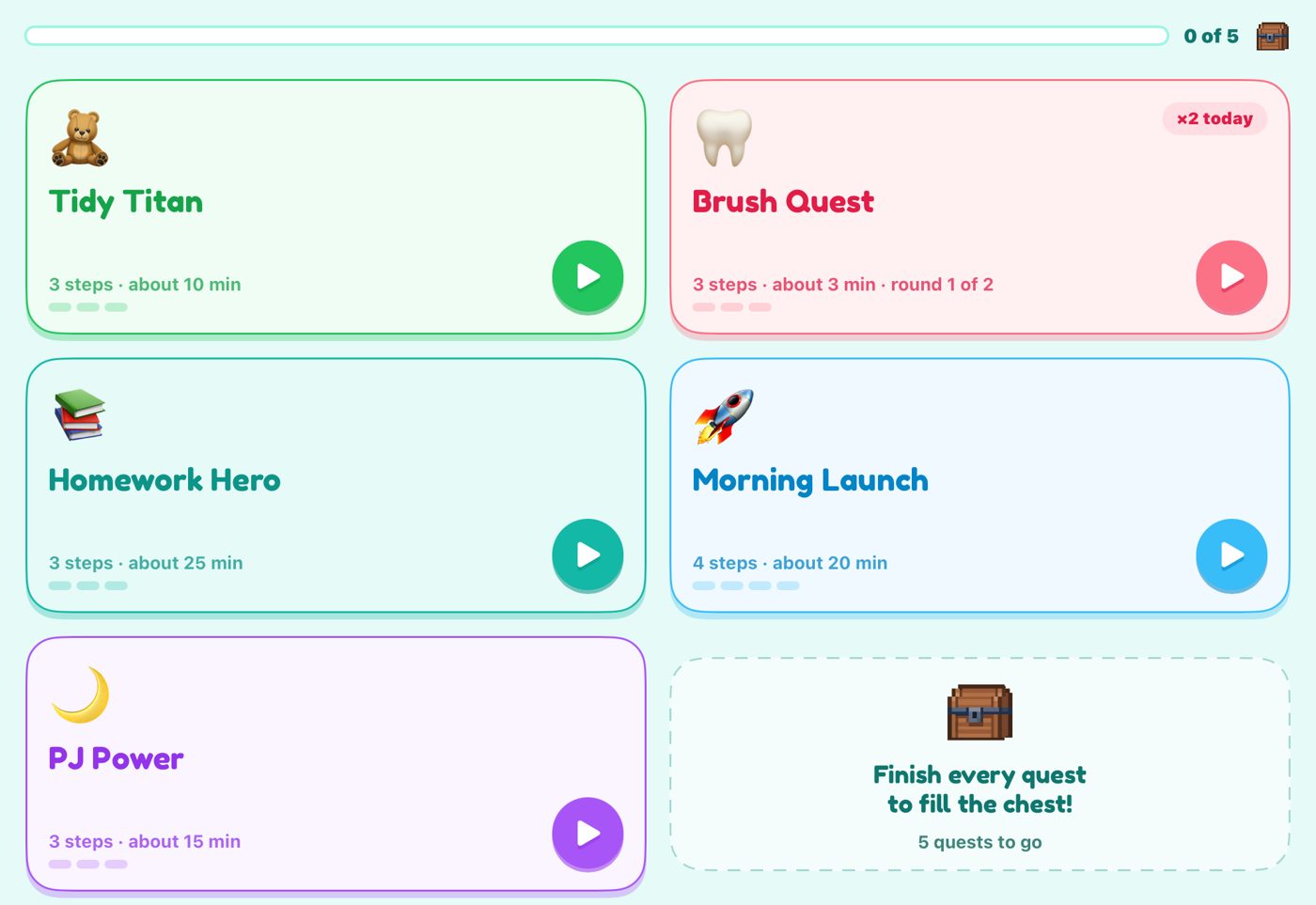
He walked past it, tapped a tile, and did the thing. Then the next thing. It was the first morning in months I hadn't repeated myself. My wife's only comment was "why didn't we do this before".
It's not perfect. Some mornings he ignores it. But the baseline shifted from "every step is a negotiation" to "most steps just happen", and that's a different life.
Why this works: point of performance
Russell Barkley, who has spent his career on ADHD, has a line I think about a lot: ADHD is not a problem of knowing what to do, it's a problem of doing what you know at the point of performance. The kid knows the routine. He can recite it. He cannot retrieve it at 7:40am with a cartoon on in the next room.
So the help has to be there, at the moment and the place it's needed. Not in his head. Not in my voice. Not on a phone in a drawer. On the bench, lit up, where he eats breakfast.
Occupational therapists have been saying this for decades with flip charts, laminated cards on the bathroom mirror and Time Timers. The whole reason a $300 wall calendar sells is that it's always on and in the kitchen. The features are secondary. Parents who say "I want a digital chore board, not an app" are describing exactly this, and they're right.
The other things we learned
- My voice is noise. A picture is information. For a kid with auditory processing issues, verbal instructions are the worst possible channel. Once the list was visible, I stopped saying the instruction and started pointing at it. Huge.
- Three or four things, max. We tried eight. He stopped looking at the board entirely. Three worked, then we added a fourth.
- The celebration matters more than the points. He doesn't care that the star count went up. He does walk over to watch the little fanfare when the last step is done.
- If a parent has to approve or unlock anything daily, it dies within a week. I'm ADHD too. This one is personal. Routines have to recur on their own and rewards have to be self-serve.
- Night-before beats morning-of. Anything that can be done the evening before, when meds are still working and there's no time pressure, should be. More on that here.
How to do this with whatever you already have
You don't need my app for the core idea. Here's the version that costs nothing:
- Pick one routine. Mornings, probably. Leave the rest messy for now.
- Write the three or four steps as pictures, not words. Print or draw them.
- Stick them where each step happens. Teeth on the mirror. Clothes on the wardrobe. Bag by the door.
- Stop saying the instruction. Point at the picture.
- One real reward at the end, something they already want, no lecture either way.
If you have a spare iPad, the Quest Board in QuestStep is that idea with a timer and a celebration built in. Open it, turn on Guided Access so the iPad stays on the board, and leave it on the bench. That's the whole setup.
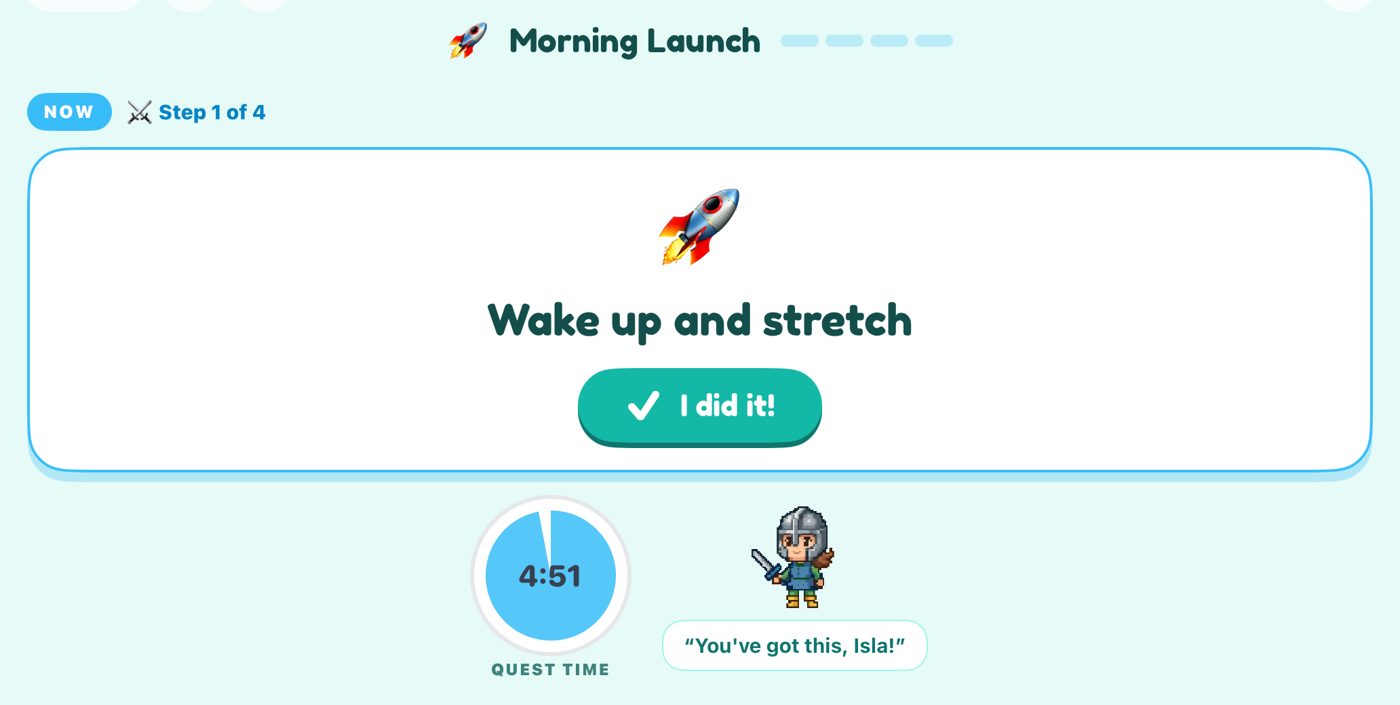
A whiteboard does 80% of this for free. The iPad adds the timer, the celebration and the fact that it resets itself every day so nobody has to update it. Whether that last 20% is worth it depends on your kid. For mine it was the difference between a chart that lasted two weeks and a board that's still on the bench.
QuestStep is the app I built for my own kids after all of this. Free plan does the whole Quest Board; iPhone and iPad. If it's not right for your family, the posts above should still help.
Download on the App Store